
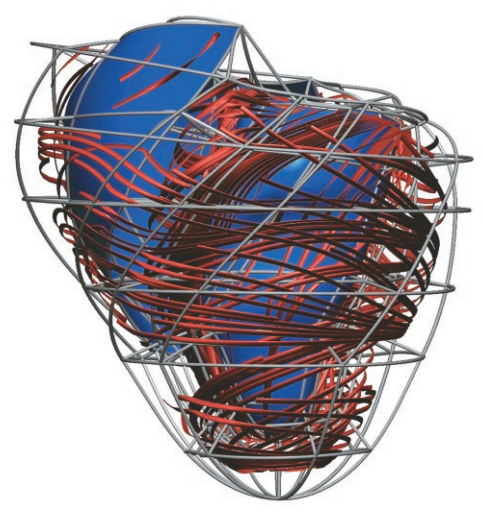
“Computer models of the heart incorporate detailed experimental information, both at the level of individual cells and at the level of anatomy. Here, a model developed by Peter Hunter’s team at the University of Auckland portrays the changing orientation of the heart’s muscle fibers from the outside to the inside of the heart wall. The spiraling of the fibers is believed to affect the flow of electric signals through the heart. Courtesy of Peter Hunter, PhD, Bioengineering Institute, The University of Auckland, New Zealand.”–Via.
The following video accounts for how blood gets oxygen. Veins and arteries trace pathways; the heart is a pump that relays oxygenated blood to the rest of our bodies. While you observe this video, keep in mind that the heartbeat is regulated by electricity; it obeys a continuous rhythm that has never stopped.
 The Hypertextual Lounge
You must be logged in to post a comment.