
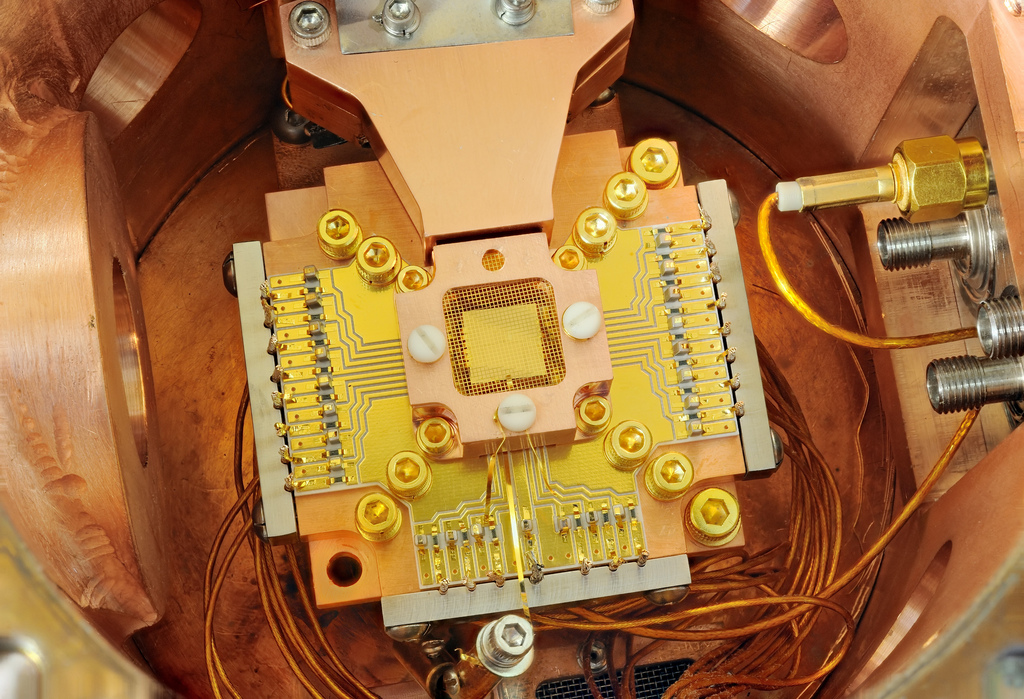
“Someday quantum computers will, their cheerleaders swear, sift through unprecedented volumes of information and solve processing problems once thought intractable. The military hopes to use them for extra-secure encryption, biologists hope to use them to unpack the mysteries of proteins, investment banks hope to use them to analyze minute market fluctuations, and everyone hopes to use them to store giant caches of data. But quantum computing is still a young field, and quantum computers can’t do any of it yet. At present, the one in front of me can factor the number fifteen.”–Via.
The following short film crams a lot in a very limited time frame: philosophy, technology, science, quantum mechanics, etc. It gives a first look account of what could very well be the next big step in computing. Quite enthusiastically, it depicts the possibilities behind harnessing quantum technology:
“The film takes a look at various researchers working on the project, as well as the computer itself, which has to be operated at near-absolute-zero temperatures. Researchers hope the quantum architecture will eventually be used to optimize solutions across complex and interconnected sets of variables currently outside the capabilities of conventional computing. That could allow for new solutions in computational medicine or help NASA to construct a more comprehensive picture of the known universe. “We don’t know what the best questions are to ask that computer,” says NASA’s Eleanor Rieffel in the video. “That’s exactly what we’re trying to understand.”” — Via The Verge
In the next few weeks, we’ll begin a discussion about photosynthesis. Even when quantum mechanics is way beyond the grasp of what we can discuss in a High School Biology course, it is interesting to know that the nature of light–its behavior, especially in the context of chloroplasts, which regulate photosynthesis–can be understood through quantum concepts.
The film–of about six minutes–puts forth very interesting topics that we have discussed in class regarding the nature of science, our place in the universe, and technological progress.

 The Hypertextual Lounge
You must be logged in to post a comment.