
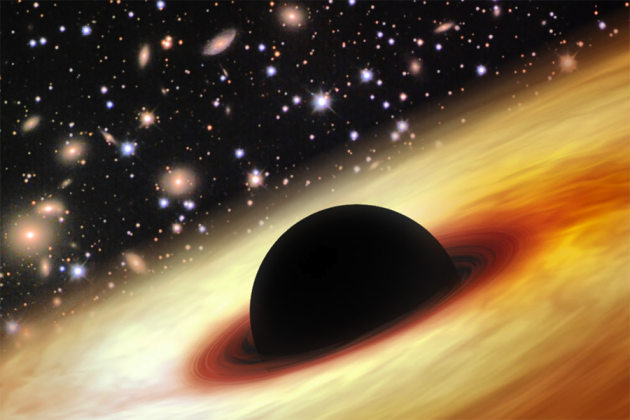
“A black hole that grew to gargantuan size in the Universe’s first billion years is by far the largest yet spotted from such an early date, researchers have announced.”–Via
We’ve discussed the Cosmos in our Bio class. Human beings are part of it, and can be aware of many things in it—which include stars, photons, bacteria, and plants. Everything is the Cosmos, but only we, with our huge and strange brains, are aware of it. Science helps us deal with this strange condition that puts us in a weird, but exciting situation: being aware of how infinitely small and how infinitely big things can get. This is why I’ve decided to update the blog with the Galaxy Song, by the comedy group Monty Python. The song was part of the soundtrack of the 1983 film Monty Python’s The Meaning of Life (1983):
(spoken)
Whenever life gets you down, Mrs. Brown,
And things seem hard or tough,
And people are stupid, obnoxious or daft,
(sung)
And you feel that you’ve had quite eno-o-o-o-o-ough,
Just remember that you’re standing on a planet that’s evolving
And revolving at 900 miles an hour.
It’s orbiting at 19 miles a second, so it’s reckoned,
The sun that is the source of all our power.
Now the sun, and you and me, and all the stars that we can see,
Are moving at a million miles a day,
In the outer spiral arm, at 40,000 miles an hour,
Of a galaxy we call the Milky Way.
Our galaxy itself contains a hundred billion stars;
It’s a hundred thousand light-years side to side;
It bulges in the middle sixteen thousand light-years thick,
But out by us it’s just three thousand light-years wide.
We’re thirty thousand light-years from Galactic Central Point,
We go ’round every two hundred million years;
And our galaxy itself is one of millions of billions
In this amazing and expanding universe.
(waltz)
Our universe itself keeps on expanding and expanding,
In all of the directions it can whiz;
As fast as it can go, at the speed of light, you know,
Twelve million miles a minute and that’s the fastest speed there is.
So remember, when you’re feeling very small and insecure,
How amazingly unlikely is your birth;
And pray that there’s intelligent life somewhere out in space,
‘Cause there’s bugger all down here on Earth!
Here’s an illustrated version of the song, put together by Phillip Harrington, for his undergraduate astronomy classes at Suffolk County Community College on Long Island :

 The Hypertextual Lounge

You must be logged in to post a comment.