
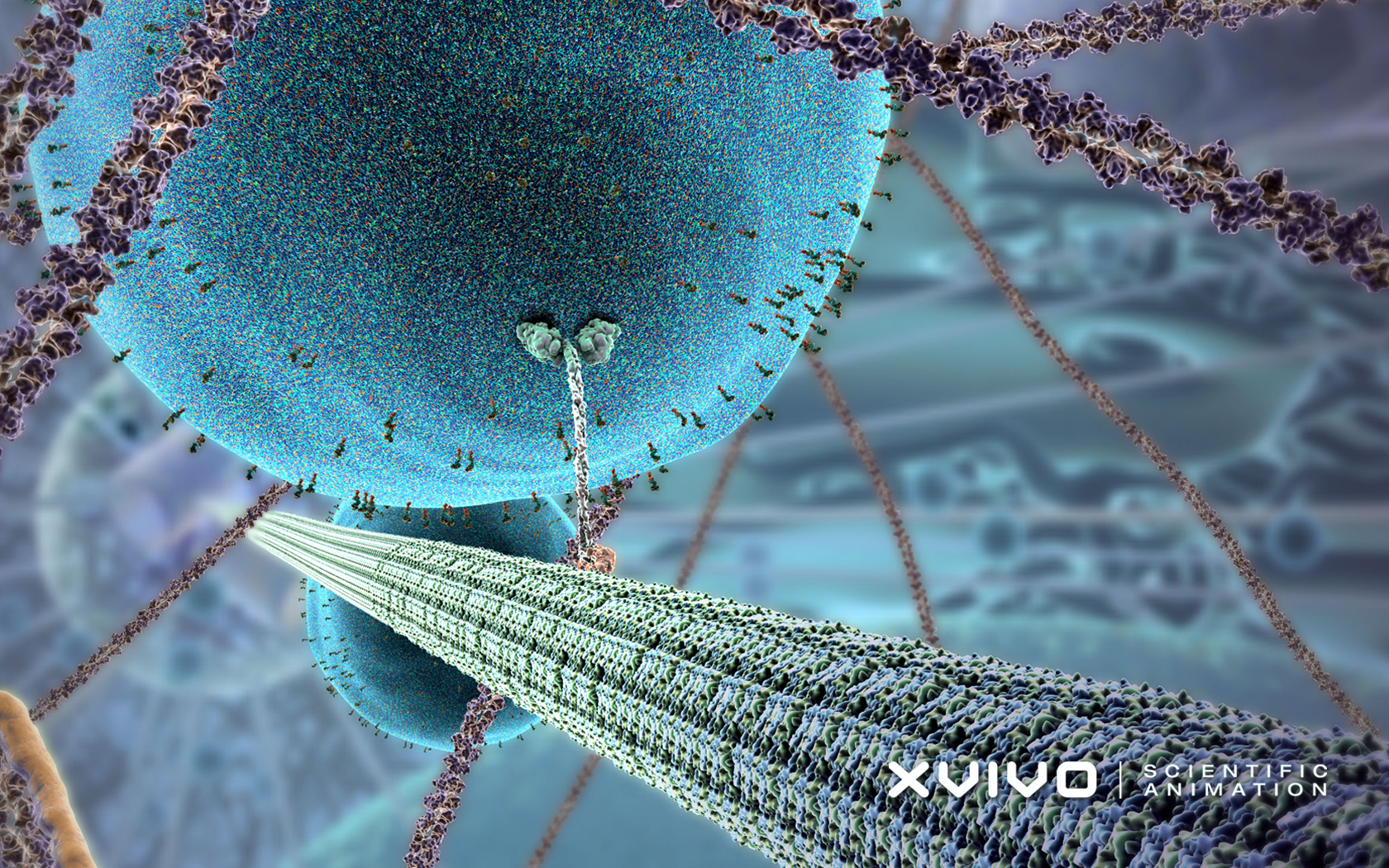
Kinesin protein walking on a microtubule.
We’ve been discussing a new level of our hierarchical organization of life: cells. Everything we’ve discussed about biological molecules, polarity of water, functional groups, organic chemistry, hydrophobic, hydrophilic interactions, protein manufacture, etc., leads up to the cell.
In this post I will share videos that account for the microscopic universe of cells. Art, science, and technology crossed paths for each video. Notice themes we’ve discussed in class in each video, and align them with our class discussions–
Fanfarlo – Cell Song
Macro Kingdom III
The Hidden Life of the Cell
 The Hypertextual Lounge
The universe may grow like a giant brain, according to a new computer simulation.
http://www.livescience.com/25027-universe-grows-like-brain.html
http://sprott.physics.wisc.edu/pickover/pc/brain-universe.html
LikeLike
That is a very nice theory, I think that with time we (all life on Earth) will indeed grow with the universe itself.
LikeLike
We are growing with the universe, Ian. We are the universe aware of itself.
LikeLike
http://www.biology4kids.com/files/art/cell_vacuole1.jpg Here I found an example that explains how a plant would look like if the cell’s vacuole were empty. This is a legitimate explanation because it tells one that a cell without a vacuole(water), would not have the energy to perform any process necessary for the plant’s life.
LikeLike
We are used to believe that architecture and structure is something unique to man-made stuff, like buildings, for example. But cells require structure and architecture. Vacuoles, microtubules, and other vesicles, provide this much needed shape.
LikeLike
Using art, the Cell Song portrays themes we have studied in class such as the biological levels of organization. One verse says, “Each little cog sticks to the next, how can it be that they’re alive”, it refers to the many parts that go together to make up living organisms. For example, organelles doing their job build up a functional cell. The song explores the various levels of life until reaching a person to show the listener that all these units of life working together make us who we are.
http://www.dezeen.com/2014/04/20/ewan-jones-morris-animation-for-cell-song-by-fanfarlo-explores-biological-structures/
LikeLiked by 1 person
Fanfarlo is the name of a novel written by the French poet, Charles Baudelaire. This said, I cannot think of a more hipstery band than this one (possibly Arcade Fire). In other words, your Bio teacher is coming out as an aging hipster.
On a more serious note, the video does account for the organization of life, including the topic we’ve recently discussed: compartamentalization. “Each little cog” is an organelle, and each organelle accounts for a part of a whole. This whole is a cell, which has all the functions of life included in it.
LikeLike
Cell have developed quality control systems because of misfolded proteins which are dangerous. Proteins are involved in many of the structural functions and regularity aspects of the cell.
LikeLike
http://phys.org/news/2014-09-quality-pathway-cell.html
LikeLike
Shape is a pretty big deal in Biology. Shape in molecules, such a proteins, determine shape of cells, and shape of cells can mean the success of a whole species.
LikeLike
Any living cell carries with it the experience of a billion years of experimentation by its ancestors. (1949)
— Max Ludwig Henning Delbrück
After years of study, and many, many more to come, no human-made technology has been able to match the efficiency of cells. They can perform an incredible amount of necessary processes for life in much less than a second; even though its tiny, it gets the jobs done! The discovery of cells and cell parts have not only helped biologists but many other fields of study like chemistry, astronomy, archeology, genetics, literature, history, and so on. Scientists all around the world have spent decades studying cells and even though much has been discovered, there are still numerous mysteries to uncover.
LikeLike
A billion years of genetic recombinations in trillions upon trillions of cells will yield results such as the one you see in your mirror everyday. This ‘experimentation’ that Max Ludwig Henning Delbrück refers to in your very appropriate quote, is nothing less than natural selection at work, and thanks to scientists such as Rosalind Franklin, we can account for natural selection by understanding how the recipes for proteins get passed from one organism to the next.
LikeLike
It is a known fact that the complexity of living organisms is a direct cause of the hierarchal organization of life, especially of the basic unit of life: cells. In class, we have discussed and seen how cells are worlds of their own. In the video above, Micro Kingdom 3, it is visible that each cell is a microscopic universe. This idea leads to the theory that the universe too is a small part of something bigger. Using magnification with different technologies, scientists have been able to find a resemblance between microcosms and macrocosms. Consequently, this would suggest the possibility of being part of a scaled up infinite. In other words, our universe may just be a cell in another organism’s body, and so on.
For example, in pictures one can be very easily confused between an image of the known, observable universe and an electron cloud inside a hydrogen atom. Similarly, neurons are said to resemble the universe, an eye a nebula, and the birth of a cell to the death of a star. The macrocosms and microcosms, both have many unstudied parts and places where humans still cannot reach, but definitely as more time passes and technologies advance, more information about these unknown universes will come into view.
To see a world in a grain of sand
And Heaven in a Wild Flower;
Hold Infinity in the palm of your hand
and Eternity in an hour
— William Blake, “Augaries of Innocence”
/Users/melanietacher/Desktop/unnamed.jpg
/Users/melanietacher/Desktop/brain-cell-the-universe-birth-of-a-cell-death-of-a-star-eye-nebula.jpg
LikeLiked by 1 person
http://sprott.physics.wisc.edu/pickover/pc/brain-universe.html
http://www.redditpics.com/a-brain-cell-vs-the-universe-birth-of-a-cell-vs,877319/
LikeLike
William Blake is one of my favorite poets. His writings and illustrations show us that we can be amazed by nature in ways that inspire and make us better. This same amazement, which fueled the minds of artists such as van Gogh, can be seen in scientists as well. To know that we are small, and that universes exist in our bodies, and that the universe we are part of, probably, is but one of countless millions, like modern quantum mechanics suggests, is one of the biggest achievements of humanity. ‘We are the universe aware of itself’ works for scientists and artists.
The human experience cannot be better put. I suggest you read Jorge Luis Borges’s poems.
The following poem is called ‘Happiness’, and it is very much related to the Blake tradition of gazing the infinite (Borges was influenced by William Blake), something scientists do everyday–either by observing stars or cells:
Happiness:
Whoever embraces a woman is Adam. The woman is Eve.
Everything happens for the first time.
I saw something white in the sky. They tell me it is the moon, but
what can I do with a word and a mythology.
Trees frighten me a little. They are so beautiful.
The calm animals come closer so that I may tell them their names.
The books in the library have no letters. They spring forth when I
open them.
Leafing through the atlas I project the shape of Sumatra.
Whoever lights a match in the dark is inventing fire.
Inside the mirror an Other waits in ambush.
Whoever looks at the ocean sees England.
Whoever utters a line of Liliencron has entered into battle.
I have dreamed Carthage and the legions that destroyed Carthage.
I have dreamed the sword and the scale.
Praised be the love wherein there is no possessor and no possessed,
but both surrender.
Praised be the nightmare, which reveals to us that we the power to
create hell.
Whoever goes down to a river goes down to the Ganges.
Whoever looks at an hourglass sees the dissolution of an empire.
Whoever plays with a dagger foretells the death of Caesar.
Whoever dreams is every human being.
In the desert I saw the young Sphinx, which has just been sculpted.
There is nothing else so ancient under the sun.
Everything happens for the first time, but in a way that is eternal.
Whoever reads my words is inventing them.
LikeLike
Since the beginning of time up until now, science and art have depended on each other for their evolution. For some, these two fields of study may seem immensely different, but in fact they are not. Art and science have more alike than different. Nowadays, artists and scientist are collaborating more and helping each other to create or discover new things. Below are some links that show the collaboration of art and science during the late 1400’s and from an artist nowadays.
Leonardo Da Vinci is a perfect example of how art and science were married so one would have a better understanding of something. Below is a link that explains how this was achieved in one of his most famous works.
http://theartinscience.blogspot.com/2010/07/who-heck-is-vitruvian-man.html
Here is a brief description of Fabian Oefner, modern day artist, and his work:
“Fabian Oefner is a talented photographer based in Switzerland whose work marries visual aesthetics and science. He works from his photo studio on assignments for various industries and realizes free projects. Most of his work has to do with bringing science and art together. He often uses natural phenomena that appear in our daily lives, being it sound waves, or iridescence, responsible for the stunning colours in soap bubbles. The main aim of his work is to show these phenomena in previously unseen and poetic ways, encouraging viewers to pause for a moment and appreciate the magic that constantly surrounds us.”
http://www.tedxwarwick.com/talks/talk.php?year=2013&id=6
LikeLike
Great video, Tatiana.
Actually, in antiquity, a scientist and an artist were two sides of the same coin. It it a very modern thing to consider both fields separated from each other.
LikeLike
The third video shows tha cells have a universe on there own inside every single cell. In the video the nucleus looks like our sun, and it is also in the middle and controls everything around it. It is amazing how every protein and organelle know what to do. And it is more amazing to think this is happening every second in our bodies.
LikeLike
http://naturedocumentaries.org/3972/hidden-life-cell-bbc/
http://www.bbc.co.uk/programmes/b01nln7d
LikeLike
Check out this image of the sun, taken about a year ago, by a scientist and photographer Alan Friedman (this image is also part of the blog logo):
LikeLike
Looking at this post I see all the things that happen in a cell and its amazing how all this things happen with the size a cell has. I now understand that there is not a thing that is more organized and complex than a cell.
LikeLike
I find it amazing how scientists are doing this job of creating animations to make us see how the cell and its processes actually look. We get to understand them better. I found this other very interesting award winning animation of viral replication.
http://www.xvivo.net/animation/the-inner-life-of-the-cell/
LikeLike
I would’ve benefited a lot from animations like these as a bio student. Eben now I’m learning new stuff about cellular biology thanks to these models.
LikeLike
A cell is like a factory, it has many different areas to work in. Every organelle of the cell is needed to perform all the processes inside the cell, like every job in the factory. For example: the RNA from the nucleus is a recipe that is used to assemble proteins by ribosomes in the rough ER. After the proteins are assembled, vesicles transport proteins to the Golgi apparatus which modifies proteins and packages them in new vesicles. To end the protein synthesis, the vesicles release proteins that have destinations outside of the cell. In the factory the boss would order the workers in the assembly line to make the product that is made in the factory. After the product is made, it is transported to the finishing/ packing department where it would be boxed and sealed. To finish this process, the product would be exported from the factory to a place where it can be used. In this website organelles from the cell are being compared to jobs in a factory.
http://sciencenetlinks.com/student-teacher-sheets/comparing-cell-factory-answer-key/
LikeLike
The factory metaphor is a good one because it help us visualize the interdependence between all the working parts of the cell.
LikeLike
It is very interesting to see how the band decided to represent science and how it has been used in the Cell Song. I also find interesting and quite smart how they compare viruses with dictators and nuclear bombs. This example can help visualize the damage a virus can do to a cell, since the nuclear bombs are an example of some of the bad things science has been used for. Just like a virus can affect the cell, these bombs had a very bad impact in the world: http://www.motherearth.org/nuke/begin2.php
LikeLike
If you liked this song, which combines science and art, I strongly recommend the Icelandic artist Bjork, from the album Biophilia:
LikeLike
Watching the video Macro Kingdom 3 is incredible to since we can see these changes and processes take place. The most amazing thing about it is the fact that the things we see on the video have such a huge impact and are a big part of life existing on Earth. This video makes me wonder what would happen if these changes and processes didn’t take place. http://carbonomics.net/MCcarbon/Carbonomics/13c10/13c10d.html
LikeLike
So much depends on so many things that we cannot see with our eyes. That is an amazing thing.
LikeLike
“To develop a complete mind; study the science of art; study the art of science. Learn how to see. Realize that everything connects to everything else.” – Leonardo Da Vinci
Everything in life is connected even if it is not obvious; for example science and art. To most people science and art are complete opposites. One is driven by logic and reason, while the other is emotionally driven. This fact alone makes them seem worlds apart; but science and art share more similarities than they do differences. Both are fields of study that ask and deeply search for answers. It is in these fields, that mistakes and open-ended inquiries are welcomed as are part of the learning process. The previous videos are a great example of how science and art relate. Also, using art the videos show an interesting way of how everything within a cell relates to one another.
http://blogs.scientificamerican.com/guest-blog/2013/07/11/artists-and-scientists-more-alike-than-different/
LikeLike
Great article, Andrea.
LikeLike
There is an idea that mitochondria may have been a microorganism by itself. This link gives an insight of the origins of this important organelle.
http://thebrain.mcgill.ca/flash/i/i_05/i_05_cl/i_05_cl_her/i_05_cl_her.html
LikeLike
Its fascinating how the band joined art, science and technology with the objective to educate people of the smallest but most crucial structural unit of all organisms. I found an article that scientist are trying to clone human cells using the process of the nuclear transfer they used with dolly the sheep in 1996. I’ve always wondered if human cloning would ever be possible?http://news.discovery.com/tech/biotechnology/adult-human-cells-cloned-for-first-time-140418.htm
LikeLike
The “Cell Song” is a fun and creative way through which people can learn about the cell, which is the most important element of life. Without the cell the mankind wouldn’t exist given the fact that cells make tissues, tissues make organs and organs make systems; therefore it all leads back to the cell. One of the different types of cells that our body contains is the stem cell, a cell that has the capacity of developing into other types of cells. People have been debating over this type of cell and a stem cell research has been held for some time but it wasn’t until recently that scientist found worthy outcomes to them.
LikeLike
http://www.washingtonpost.com/opinions/stem-cell-researchs-potential-worth-supporting/2014/10/11/a62e167e-50ab-11e4-8c24-487e92bc997b_story.htm
LikeLike
It’s nice to see that the media is actually educating people and getting people to become interested about science, instead of informing us about whatever celebrities are doing. The media is a big thing and it greatly affects our society, if we were to have more things that can make us think aand learn, then our society would be so much better.
LikeLike
https://www.youtube.com/watch?v=8FRq5Bpre-Q Lecture 3
In this document series Neil deGrasse Tyson describes marvelous things. Lecture 3 is the most relatable to this blog post.
He describes that a miniscule difference of 1% in DNA separates of from chimps. Obviously our cellular structure does vary in great ways. DNA variations ultimately cause cell variations.
Cells make up animals; we all know that. But some of those animals can survive in the “hostile” environment of space. So I wonder what can their cells do that ours can’t? Why and how can their cells withstand such conditions but ours can’t? This becomes even more mind-boggling when you think that essentially all cells are made up of the same stuff; that being star stuff. All animal cells have the same membrane bound organelles, at least in the Biology book that is stated. Life, however, has some exceptions, even our scientific laws do, such as Newton’s law of gravity which Einstein’s laws of relativity rescued. deGrasse states it in Cosmos. But the real mind-boggler is what drastic difference can there be between their cells and ours that allow them to be the ultimate survivors?
LikeLike
LikeLike
As I learned in Chapter 4, cells are an amazing microscopic universe. They are life’s tiniest machine that can perform all life’s processes. Also, they are far more efficient than any machine that humans have invented. It is incredible how fast the cell functions and how efficiently it produces and releases waste. To conclude, I leave you with an little article that was interesting that left me with a question: Are red blood cells prokaryotic or eukaryotic cells?
LikeLike
“Using a cell-culture system we were actually able to watch the cells divide, go through hemoglobin synthesis and then lose their nuclei,” says Lodish, who is also a professor of biology at Massachusetts Institute of Technology. “We discovered that the proteins Rac 1, Rac 2 and mDia2 are involved in building the ring of actin filaments.”
This is a pretty big deal. Thanks for sharing, Andrés.
LikeLike
http://wi.mit.edu/news/archive/2008/how-red-blood-cells-nuke-their-nuclei
LikeLike
Cells are the basic unit of life. The human body is composed of trillions of cells. These cells provide structure for the body, they take nutrients from food, transform those nutrients into energy and carry out specialized functions. Cells also contain the body’s hereditary material or DNA which allows the cells to make copies of themselves. http://ghr.nlm.nih.gov/handbook/basics/cell
LikeLike
Thanks to the new discoveries of the cell, people can understand better why the body reacts how it does and how. The inside of a cell is a little universe, it has many organelles and all have different jobs to do that explains many of our body’s reactions. we can now have a better understanding of life because of this.
LikeLike
These new discoveries, along with information technology, are very helpful for students and teachers alike. A lot more makes sense when looking at these animated models of the cell. I’ve understood concepts with these models that were incomprehensible to me 15 years ago.
LikeLike
The cell itself, is a very intricate and organized thing. It makes up our whole body and enables us to carry out our daily lives. Each different type of cell in our body, performs different functions that help us.
As to the organization discussed in class, cells make tissue, and tissues make up organs, while organs working together make up an organ system, for example, the organs that enable us to eat, swallow, and digest food. I still cannot believe and stand amazed at how small a cell is, and how important it is to every living organism.
http://www.scienceclarified.com/Ca-Ch/Cell.html
LikeLike
It is impressive how many processes the cell can undergo with its small size. The cell song was made for us to learn about the cell. The cell is the structural, functional and biological unit of all organisms, without them we would be nothing.
LikeLike
The metaphor of universe when talking abut the cell is very fitting.
LikeLike
“If we examine the accomplishments of man in his most advanced endeavors, in theory and in practice, we find that the cell has done all this long before him, with greater resourcefulness and much greater efficiency.”
-Albert Claude (1974)
It’s astonishing how the cell despite its small size is capable of performing all these different processes vital for life. Cells are the building blocks of life and are far more efficient than anything we have ever created. We underestimate cells even though they’re constantly working and making life possible. It’s interesting how every time we learn more about cells we realize how complex they are and that there is still much to discover.
LikeLike
Nothing is more complex than life. Any astrophysicist can tell you this. Stars behave more or less the same way; gravity is the same everywhere. But life requires many conditions to exist. In other words, life is precious. A bio course should enable us to respect the wonders we may find in ants, pineapples, the fractal pattern of broccoli, and even the bacteria that live in our gut.
LikeLike
http://www.evolutionnews.org/2013/06/did_scientists_072871.html
LikeLike
At first glance the cell seems simply like the building block of organisms when actually it is one of the more complex part of our bodies. Out of select combinations of elements it carries out the most important job for living organisms, keeping them alive. Plus, they are so meticulously crafted that the slightest anomaly in cells can completely change the organism they’re in.
LikeLike
Life is tricky. I suggest you do a Google search of the Drake Equation; it might give you some insight as to what chances are there—if any—of finding the “select combinations of elements [that carry] out the most important job for living organisms, keeping them alive.”
LikeLike
Everything that happens within a cell is coincidence, which could lead one to dabble with the thought that we, the human race, are coincidence. Since the beginning of time, we’ve pondered our existence and our purpose in the grand scheme of things.
We are an order of events, chemical reactions, evolution, adaptation, etc. It all happens simultaneously and by chance. It’s almost mind boggling that while a human being can be governing a country, they’re digesting, processing, breathing, all simultaneously; while each of these actions is enabled by cells synthesizing proteins, creating ATP, splitting into more cells, etc., all also simultaneously and by arrangements of coincidence.
And yet, another perspective to consider is that, just as cells have their function in a tissue, a tissue in a muscle, a muscle in an organ, an organ in an organ system, and an organ system in an organism, then the same could apply to humans as part of the ever expanding universe.
This can lead to the topic of existentialism which is present in multiple literary works and other forms of artwork which serve as an outlet.
LikeLike
“Since the beginning of time, we’ve pondered our existence and our purpose in the grand scheme of things.” I agree with this statement. Given your curiosity on the topic of the human role in the universe—possibly one of the oldest problems in philosophy, and still a very poignant one, which is the reason why there’s still poetry, philosophy, and art, scientists cannot account for these questions—I’ve pasted this concept, called the ‘weak anthropic principle’, as described by the mathematician and philosopher of science, Roger Penrose. I suggest you do further research on the topic:
LikeLike
It is amaizing how small the cell is, but yet how important it is for living things. In my opinion the cell is to living things how the sun is to earth. Basically the body depends on the cell and what happens inside of it, even the smallest detail. It is like the sun which gives the earth and different animals the energy needed to survive. We need cells to survive and this is why it is so important to have our cells in a healthy way since they are so important to our lifes. They are an essential part of our bodies.
LikeLike
“Every living thing is made of cells, and everything a living thing does is done by the cells that make it up”
-L.L. Larison Cudmore
A couple of years ago, in order to study for a test, I began to understand cells in a different way. I believe a cell is similar to a company or corporation. All the roles that a person working for a company carries out, such as a CEO or a secretary, they all fit into the description of a cell. From important positions to minor positions, every single one of the people who work in the company, in this case the organelles that work for a cell, has a big impact on the direction in which the company or cell goes. They all have to work together to manage things out and make the best they can as a team. Teamwork is what a cell is all about. They all have to try to create balance and stability in order to “succeed”.
LikeLike
The concept “synergy” comes to mind with your comment, Adriana. Look it up.
LikeLike
It is amazing how the cell with such a small size can perform all the complex processes and developments it does. The fact that all this processes require a lot of energy and advanced mechanism that it has to do and its all is required for life. As a matter of fact us humans will never be able to manage such developments and advances the cell undergoes even though we are bigger in size we are not prepared nor equipped to math the efficiency and sustainability of a cell. The cell’s sustainability could be mostly attributed to the lysosomes which breaks down food and bad organelles that will later be recycled. For more information about Lysosomes: http://www.ncbi.nlm.nih.gov/books/NBK9953/
LikeLike
It is impressive how the cell works that even though hundreds of processes can happen simultaneously and almost everything goes where it is supposed to. The complexity of cell is unbelievable yet copies of the chromosomes and RNA happen with extreme accuracy the chances of error are between 1 in 100 million and 1 in 1 billion.
LikeLike
It is incredibly fascinating how something so minuscule can be so powerful and important for life. This combination of art and science is a great way to help people finda a better understanding of life’s most essential component, the cell. With these spevial sources that use different animations, analogies and metaphors to describe the cell, people can learn in great detail how the cell works and how universe inside of the cell is what helps create the universe outside of the cell, which is also the universe in which we live in.
LikeLike
It is amazing how we depend on such a small thing as the cell. Stem cells are cells that can develop into different kinds of cells. Here are some interesting facts about stem cells.
http://onlinebiologydegree.org/2011/15-interesting-facts-you-may-not-know-about-stem-cell-research/
LikeLike
The video of The Hidden Life of a Cell amazes me in so many ways. To see how advanced our technology is in order to be able to see the life within a cell is incredible. This technology advancements also help our knowledge of the building blocks of life. It is so amazing to literally see how suck a small thing can carry out these functions all around our bodies that keep us alive. I honestly can’t wait to see what new technology advancement comes next and what abilities we will have thanks to it. http://scienceadvances.org
LikeLike
It is impressive how the cell, with a size so small is the base of our life, how the cells has a system of its own that is interdependent with other cells and other factors that make us. The cell, being extremely small, performs crucial processes that maintain our life going, making the cells our support. Even though it seems that they are not important with their small size and that inside them things are not important, the system inside it is extremely important making the processes necessary for us to keep on living, therefore no matter how small the cell is it is extremely important in our life.
LikeLike
I agree with you very much.
LikeLike
It is amazing how the cell is so small and have such a level of perfection. It carries out processes which need a enormousness amount of precision and even a small malfunction can cause a collapse to the whole process. Cells have proven that they are a vital part in every life on Earth. Without them, there would be no us.
http://www.bbc.co.uk/programmes/b01nln7d
LikeLike
I think these videos combine art and science wonderfully to show us things we wouldn’t normally see or think about. I especially liked the second video, because it is very simple and presents the beauty of the way things are without having to add much to them. After watching the first two videos in the Macro Kingdom trilogy, I am in awe of how some magnification can go a long way.
LikeLike
The macro series are amazing works of art.
LikeLike
Thanks to advances in technology, we can see the functions and sizes of cells. Without them we wouldn’t be here on Earth. We are created by trilions of cells which work and do their necessary jobs to keep us alive. It’s even easier to understand of what organelles the cell is made of by using models in the internet. http://www.cellsalive.com/cells/cell_model.htm
LikeLike
It is extraordinary how such small units are capable of sustaining life. Such small units are responsible for the different things that make us us such as genetic factors, DNA, the producing of energy, among other key aspects that affect life. They perform crucial processes that sustain life and even though they are the smallest unit that can perform the many diverse life processes, they are also the most important ones.
LikeLike
And things can get even smaller, about a 1,000 times smaller than a proton.
LikeLike
Are red blood cells prokaryotic or eukaryotic cells?
Scientists have struggled to understand the mechanism by which maturing red blood cells eject their nuclei. Now, researchers in the lab of Whitehead Member Harvey Lodish have modeled the complete process in vitro in mice, reporting their findings in Nature Cell Biology online on February 10, 2008. The first mechanistic study of how a red blood cell loses its nucleus, the research sheds light on one of the most essential steps in mammalian evolution.
LikeLike
Amazingly, stem cells are now a solution to helping people with a particular diagnosis as long as they match a relative’s cells. However, the cost is sky high. It cost thousands to freeze stem cells making it unattainable for most. This should be affordable to all.
LikeLike
I think that the next three or four decades will be crucial for stem cell research. So we’ll have to wait and see what obstacles scientists need to overcome. Let’s hope that these obstacles are scientific and not political; we can do something about scientific roadblocks, with politicians things are much more difficult.
LikeLike
It is extraordinary how complex and incredible the cell is, considering how small it is. Watching the video by BBC made me realize how important proteins are for cells. It is amazing that it takes 120 trillion cells to make a human. A multicellular organism can be compared to the universe; the organelles to the planets and stars, the cell itself to a solar system, cell tissues to galaxies, organs to galaxy clusters and groups, organ systems to superclusters, and the organism to the universe.
LikeLike
Even though I’ve known for years that the cell is the simplest living organism, I find it even more interesting when I realized how orderly and active the cell is the many different processes it has developed after millions of years of evolution. However cells still are vulnerable to mutation and being penetrated/overrun/destroyed by many viruses or bacteria, which has led me to think about how perhaps less medical advances would have possibly allowed further natural selection, allowing the strongest to survive thereby making their descents more strong. In fact, medicine and its effects on natural selection has actually been a topic of debate, but it seems that despite the intervention of medicine, natural selection and evolution have not stopped at all. And knowing that there is no “perfect cell” there might not have been a point to evolving further.
http://www.npr.org/blogs/13.7/2013/09/12/221719438
http://www.ncbi.nlm.nih.gov/pmc/articles/PMC3721656/
(The second is a full article, so at least the abstract alone should suffice)
LikeLike
I’m a huge David Attenborough fan. Thanks for sharing, Cristina.
LikeLike
It’s outstanding to believe how far science has come in the past few decades. In these few years. scientists have managed to demonstrate all the available information as to how these cell function. A highly innuitive research since the invention of the microscope in the 1600’s. However, now more than ever as we begin to continue the research on cells, scientist are left to wonder what else is their left to study about these peculiar organisms? Well scientist are still persuing every single detail as to what makes the cells work, and even more interesting they’re wondering as to what applications these cells can have for organisms when their functions are altered to serve for the basis of another function. Such as illness, body development, physical limitations (paralysis, muscular dystrophy), etc. A current example of altering these cell’s function is being applied currently into stem cell research. Within this field of research it is proposed that its original use of aiding an individual to grow from one simple cell to a wide variety of complex cell types, can be utilised to recover lost motor movement in paralysed individuals and cure specific cancers such as liver cancer. One might be left to wonder as to how much progress will humanity achieve in the following decades?
http://medicalxpress.com/news/2014-10-stem-cell-discovery-dogma-fetus.html
LikeLiked by 1 person
I could have never imagined how busy a tiny cell can be. If you look at all the functions and things going on at once in the smallest unit of life, you may see as a corporation trying to have everything functioning correctly to live. A cell that is not functioning correctly may have a disease like cancer, Alzheimer’s, cystic fibrosis, and many more. http://bscb.org/learning-resources/softcell-e-learning/why-cell-biology-is-so-important/
LikeLike
I never realized how much these animations helped students understand how the systems work, until I saw the video posted in the link. It must have be incredible to see the first men who studied down a microscope figuring out in their heads how this environments could possibly look like. Now a days we even have games, like the one we used in class “Fold it”, that play out how things work and videos that just look incredibly beautiful. And this is just the begin for animations that explain our world, the more and more years pass the easier it will be for scientist to make out their representations of the topic they are researching.
LikeLike