
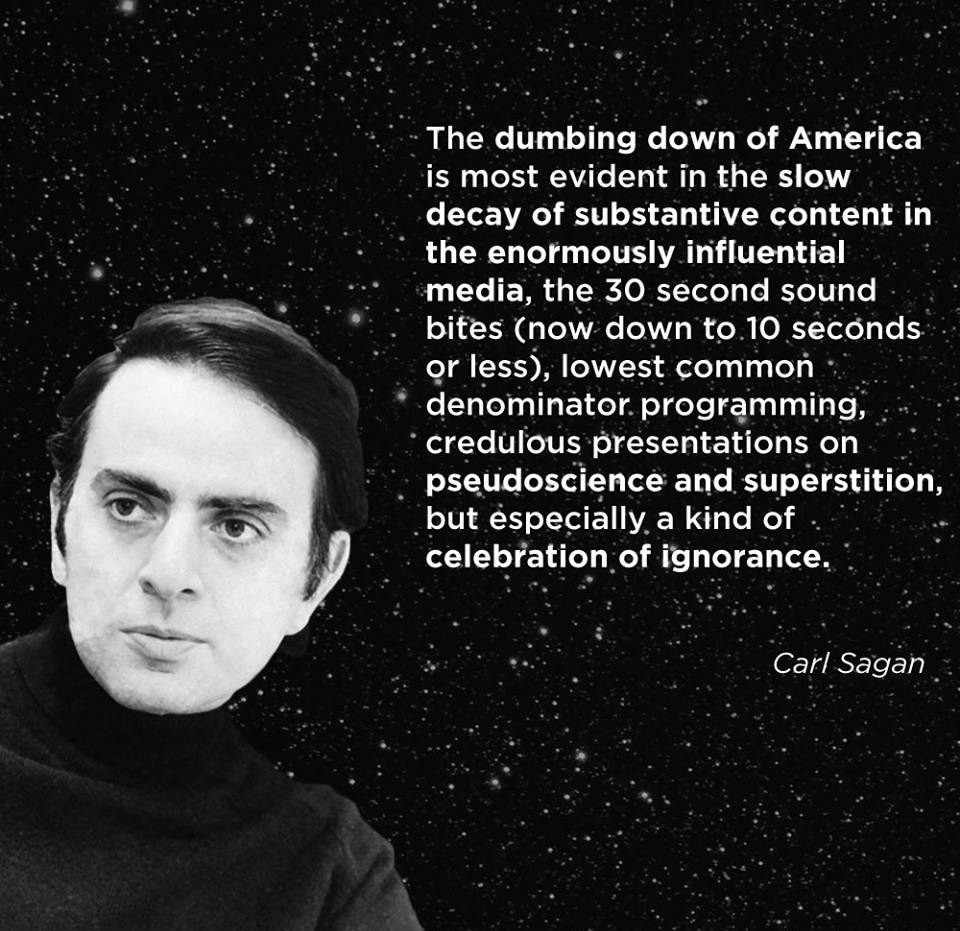
Something quite paradoxical is happening right now, during the Age of the Internet—an unprecedented time in our history which can be roughly compared to the invention of writing, more than 4,000 years ago, or the invention of the printing press, about 500 years ago—: people are getting dumber.
With more access to information, many of us would naturally believe that education should be more accessible. The fact is that yes, there is a lot more information out there, but much of it is analogous to the trans fats that we may find in junk food.
Social media is one of the mayor enablers of this pervasive diet of misinformation; and conventional media—newspaper, radio, TV, etc.—are desperately trying to get our attention with this brand of “knowledge” trying to pass as science. A positive feedback loop of misleading ideas dressed as ‘facts’ invade our senses from a lot more outlets than ever before.
What I’m referring to is what has been labeled as pseudoscience (pseudo = false): Astrology instead of Astronomy; Alchemy instead of Chemistry; Conspiracy Theories (of the Illuminati kind) instead of geopolitics.
This blog post will account for mayor conspiracies, factoids, pseudoscience detritus, etc., that get a lot of exposure in our contemporary media outlets. Take this post as a survival kit for the vast media wilderness that predatorily hungers for our attention. Links to the bogus factoids, as well as the actual, contradicting fact, will be posted along with each item of this list; the actual facts that aim to correct our misconceptions are known as debunkery. If any of you find another pseudo-scientific factoid, conspiracy theory, etc., be sure to write them in the comment section.
For each natural science there is a vast amount of pseudoscience examples out there. The most controversial ones have a lot to do with astronomy. Here are just 3 of them:
1. Ancient astronaut hypothesis:

Together Akhenaten and Nefertiti transformed the religious practices of ancient Egyptian society.
Thanks to the History Channel, this “hypothesis” has convinced a lot of people that aliens, instead of North Africans, were responsible for structures like the tombs we know as the Great Pyramids of Egypt. In fact, some ancient astronaut proponents are sure that Nefertiti, an Ancient Egyptian queen, was an alien.
Debunkery (More than 190 minutes of it) via Youtube:
2. The Face on Mars:

Small part of the Cydonia region, taken by the Viking 1 orbiter and released by NASA/JPL on July 25, 1976 Richard C. Hoagland is responsible for this notorious nugget of pseudoscientific detritus
“His writings claim that advanced civilizations exist or once existed on the Moon, Mars and on some of the moons of Jupiter and Saturn, and that NASA and the United States government have conspired to keep these facts secret. He has advocated his ideas in two published books, videos, lectures, interviews, and press conferences. His views have never been published in peer-reviewed journals. Hoagland has no university degree”– Via Wikipedia (Emphasis with bold letters is mine)
Debunkery: One word should be enough to debunk this outrageous and many other pseudoscientific claims, credulity, what people want to believe with little or no evidence.
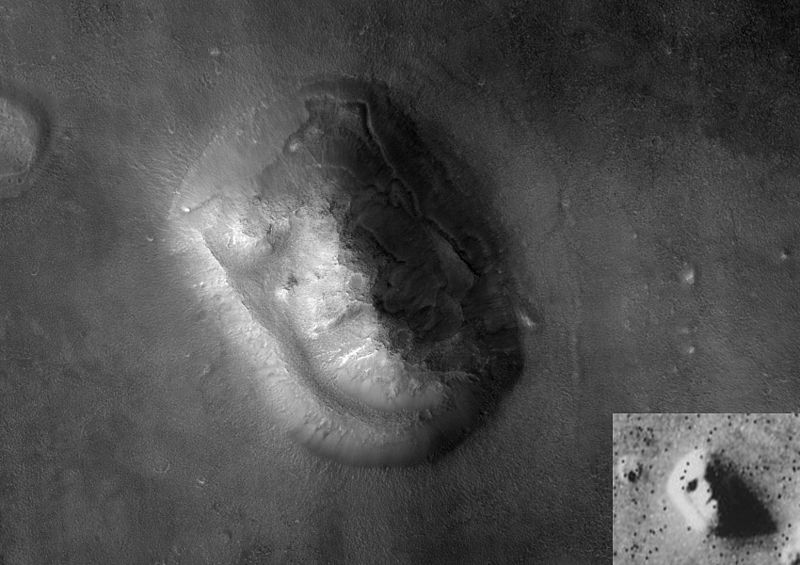
Pareidolia is a psychological phenomenon involving vague and random stimulus—image or sound—being perceived as significant. In other words, we see what we want to see. The large image on the left is a more recent one than the one at the bottom, taken in the late 70’s. The best cure to ‘pareidolia’ is high-def.
3. Moon landing conspiracy theories
In the previous video, we see astronaut Buzz Aldrin—the second man to step on the Moon—knocking the daylight out of a conspiracy theorist that called him, among other things, a coward. I do not support violence in any shape or form, but this video shows how ugly things have gotten when it comes to the outrageous claims that many credulous people want to believe.
Debunkery: With modern computing and graphics technology, computer scientists and designers have been able to recreate the lighting conditions of the lunar surface during the moon landing. Many conspiracy theories trying to pass as science revolve around light: reflections, shadows, lack of stars, etc.. These are designed to cast doubt, and claim that the moon landing was staged in a studio. The following video—a very recent one—debunks the studio claim of the moon landing with the latest graphic accelerators, used in films like Gravity and computer video games:
Another gem of debunkery is brought to us by theoretical physicist, Michio Kaku. In this podcast recording, the scientist classily debunks the major conspiracy theories put forth by a podcast listener:
Unfortunately, there are many more out there. They are very easy to find; and every year a new one appears. In many cases, centuries old pseudoscience digs its way out of the rubble of history to pollute the Facebook walls of millions. Mermaids, round earth deniers, “anti-vaxxers“, phrenology, astrology, etc., are among the most common—and in many cases—most ancient pseudoscientific claims that still claw their way into our ideological frameworks.
The following excerpt should further equip you to distinguish between science and pseudoscience.
Paul R. Thagard used astrology as a case study to distinguish science from pseudoscience and proposed principles and criteria to delineate them. First, astrology has not progressed in that it has not been updated nor added any explanatory power since Ptolemy. Second, it has ignored outstanding problems such as the precession of equinoxes in astronomy. Third, alternative theories of personality and behavior have grown progressively to encompass explanations of phenomena which astrology statically attributes to heavenly forces. Fourth, astrologers have remained uninterested in furthering the theory to deal with outstanding problems or in critically evaluating the theory in relation to other theories. Thagard intended this criterion to be extended to areas other than astrology. He believed it would delineate as pseudoscientific such practices as witchcraft and pyramidology, while leaving physics, chemistry and biology in the realm of science. Biorhythms, which like astrology relied uncritically on birth dates, did not meet the criterion of pseudoscience at the time because there were no alternative explanations for the same observations. The use of this criterion has the consequence that a theory can at one time be scientific and at another pseudoscientific.
Make your own judgements about each factoid exposed here. I encourage you to do additional research on the subject.
 The Hypertextual Lounge

It’s really saddening to understand how so many individuals around the world fall to this type of false claim. It was expected that with the dawn of the internet, a progress in the collective and wise minds of each and one us would seem to improve. However, it’s evident that wasn’t the case and as false adverstisements like the ones that plague social media outlets such as: Facebook, Instagram, Twitter, a wave of ignorance becomes for evident for the future generations to come. Furthermore, it might be possible that if this continuing trend maintains its course then our ongoing and future progress will just reverse itself . Individuals such Dr. Oz spew lies at a constant interval. This lies in his notorious “expertise” in the field of pseudoscience has proved challenging, as the U.S senate is inquiring over his miraculous weight lost supplements http://www.popsci.com/article/science/dr-oz-defends-his-pseudoscientific-claims-harmless-flowery-language?dom=PSC&loc=recent&lnk=1&con=dr-oz-defends-his-pseudoscientific-claims-as-harmless-flowery-language
It is truly outstanding how far humanity has come in terms of progress, but what’s really frightening is how fast that progress can disappear in the blink of an eye if this trend of ignorance progresses.
LikeLike
This is outrageous:
There are many more predators like this guy out there. They benefit fro ignorance and goodwill. A sad situation for millions that truly need wellbeing in their lives.
LikeLike
if it were true that the moon landing was faked, then the USA won the Space Race and, arguably, caused the decline of the Soviet Union with fraud. How could the entire world be duped? Even by today’s standards, it would take great Special Effects, CGIs, etc. to replicate the moon landing on a studio. In 1969, there were no such technological advances.
I believe that people whom choose to believe in “pseudoscience” are simple ignorant. How can people still debate the credibility of Global Warming. The most renowned scientist don’t neglect it, so why should an average joe neglect it? If Neil deGrasse Tyson were to tell you that life has been found on other planets, and his statement is supported by his peers, then should you defy him? Should one not believe such a highly regarded astrophysicist? We should believe him, for he is way more qualified in that field of study than any of us.
The people that believe the pyramids to be alien work simply didn’t pay attention in their 6th grade history class, in which diagrams, showing how the pyramids were built, are portrayed in the history books.
http://www.scientificamerican.com/article/what-is-pseudoscience/
LikeLike
I agree with your comment, mostly. I know smart, educated people—lawyers, doctors, teachers, etc.—that believe a lot of pseudoscientific factoids. Do they choose to believe in these things? Are they simply ignorant? I think that yes, there is some choice, and some ignorance when it comes to pseudoscience. But the problem, I believe, is much more complex. It has to do with ideology and psychology; aspects of human behavior that are very difficult to account for.
If there is something philosophers can still do in an age of science and Internet, is think about what it means to think. And how people reach their conclusions is a very tricky subject. Social conditions, poverty, access to education, religion, emotions, among many other aspects of the human experience, come into play when considering the question “Why would someone, in the XXIst century, believe in the geocentric theory?”
The following link is a book on the subject, seen through scope of clinical psychology: http://www.google.com.pr/books?hl=en&lr=&id=padze12cbfkC&oi=fnd&pg=PP2&dq=pseudoscience&ots=qPqxP4PsQR&sig=LmJwAqJQdEIOVmvw1wKaZStwY3o&redir_esc=y#v=onepage&q=pseudoscience&f=false
LikeLike
I completely agree with your comment, as ignorant people who choose to believe these pseudo-scientific claims are too lazy to even do the research themselves. As you’ve mentioned, there is no reason to believe ancient aliens constructed the pyramids as there is clear evidence as to how the Egyptians used different devices to move the heavy stone blocks required to build the ancient monuments.
https://www.library.cornell.edu/colldev/mideast/koslow.htm
LikeLike
It is relatively easy to find good sources of information nowadays. But for many people, I guess it is too much trouble. The whole purpose of this blog post was to show you guys how easy it can be to correct misconceptions that arise in our daily lives.
LikeLike
Many pseudoscientific hypotheses can be debunked by a relatively small amount of research. It is a popular idea that humans use only ten percent of their brain, this is based on some very early scientific ideas and certainly does not hold true today. Many people believe this hypothesis to be true even though a single Internet search will show you otherwise. The evidence is clear. It would be very inefficient for the body to have a brain that consists mostly of unnecessary mass and it has been proven that most parts of the brain are active at any given time. We must examine what we know to make sure that we do not hold any unreasonable beliefs.
http://psychology.about.com/od/biopsychology/a/10-percent-of-brain-myth.htm
LikeLike
Many of the most popular pseudoscientific ideas of today were considered science decades—even centuries—before. I agree with you: it is relatively easy to debunk pseudoscientific misconceptions.
LikeLike
As technology grows more advanced, lies can spread just as easily as information. It is always better to do some research before just assuming that something is true, but some people just assume that everything on the internet is true. Pseudoscience has been around for a very long time, we used to believe that the world is flat and that the sun revolves around our earth (and there are still people that believe that). http://www.columbia.edu/cu/21stC/issue-3.4/macdougall.html
LikeLike
This image is a model of the Hollow Earth Theory, which chooses to ignore common sense and science. It has been around for quite some time, but our current technological context has allowed for it to flourish again:
LikeLike
I find it completely absurd how people can believe such theories, as clearly there have been numerous studies, that prove Earth’s internal structure.
http://www.solarviews.com/eng/earthint.htm
LikeLike
People now a days tend to believe any “fact” or theory that they read on social media or pretty much anywhere on the Internet. One of these theories would be the Hollow Earth Theory. This theory states that the Earth on the inside is a hollow hole and the proof of this is a supposed hole on the North Pole. Many scientific information like gravity and Earth’s coastal lines have debunked this theory, but people still believe in it because they say that there is no concrete evidence of what the Earth’s center is made out of.
http://thescienceofreality.tumblr.com/post/14239460281/cwnl-hollow-earth-theory-debunked-pictured
LikeLike
An amazing thing, the fact that there has to be some effort put on debunking the hollow Earth “theory”.
LikeLike
Along with the technological advances in the last few years, an increasing thirst for fame and attention have emerged. Pseudosciences and/or fake “theories” creators seek precisely the attention received from the believers of these claims that clearly lack supporting scientific evidence. Knowledge and information is at our reach, but it is up to us and our initiative to make our own research and not permit others deceive us into believing misleading material. I believe that the thirst for knowledge is more powerful than that of recognition, the key is putting our resources to good work.
A well-known example of pseudoscience is the Bermuda Triangle.
http://www.history.com/topics/bermuda-triangle
LikeLike
Narcissism has always been a part of the human condition, but social media has exasperated it in unprecedented ways. Pseudoscientific inclinations have lot to with ego—both much and little of it—so it is not surprising that a narcissistic person is willing to go against every conceivable piece of evidence in order to ‘protect’ their beliefs, which, in many cases, serve the purpose of making that person feel better about himself (or herself). In other words, it can be said that pseudoscientific beliefs are surrogate tools for self-fulfillment. They give a false—and easier—sense of security in the face of complex issues such as the Bermuda Triangle or the terrorist attacks of 9/11; they also give a false sense of competence against people that have actual knowledge, i.e., scientists.
LikeLike
The Russian government allotted 30 million rubles ($750,000) for a social media campaign to combat rampant pseudoscience.
http://www.themoscowtimes.com/news/article/russia-to-use-social-media-in-fight-against-pseudoscience-report-says/508589.html
LikeLike
“Russian non-fiction bestseller lists are regularly dominated by titles seeking to prove the existence of mythical worlds like Shambala, Atlantis or Middle-Earth. Books declaring most of world history a fraud are also popular.”
Russia has a bad record in terms of human rights, but, and I never thought I’d say this, the are doing the right thing. This article shows that social media and pseudoscience is a global problem. Thanks for sharing.
LikeLike
I think the question is not only why people choose to be ignorant and believe without hesitation but why the real scientists waste their time and energy with worthless topics. The test for scientists is to how to inform people about the positive understanding of the world not hiw to mislead humanity with the excuse that traditional science is a deficient way to answer mystical matter.
This website poses the question of whether human civilization really cares about the truth.
http://www.csicop.org/si/show/does_truth_matter_science_pseudoscience_and_civilization
LikeLike
“For me, it is far better to grasp the Universe as it really is than to persist in delusion, however satisfying and reassuring”
Carl Sagan died one year after these words were published. Poetry in the scientific experience.
Thanks for sharing, Gabriela.
LikeLike
I think the question is not only why people choose to be ignorant and believe without hesitation but why the real scientists waste their time and energy with worthless topics. The test for scientists is to how to inform people about the positive understanding of the world not how to mislead humanity with the excuse that traditional science is a deficient way to answer mystical matters.
This website poses the question of whether human civilization really cares about the truth.
http://www.csicop.org/si/show/does_truth_matter_science_pseudoscience_and_civilization
I have extracted a fragment from the website:
“For me, it is far better to grasp the Universe as it really is than to persist in delusion, however satisfying and reassuring.”
I agree completely with this fragment. I much prefer to know all of the facts than to just accept and believe anything that is said to me or posted online even though it’s the easy way out, because for me the truth is worth knowing.
LikeLike
The legacy of Carl Sagan lives on. The words you’ve pasted on your comment are his words. Let’s hope more people discover his teachings about him, which are so desperately needed in this age of Information.
LikeLike
It’s stupid how people belief in this pseudoscience. Poeple that belief in this don’t use their logic. How can you belief that the US did not went to the moon, that pyramids were built by aliens? It is really stupid to belief in this things.
LikeLike
I agree that it can be very frustrating, but we must respect other people’s beliefs. What might be stupid for a lucid mind, is very dear and valuable for the person believes in, say, the Loch Ness Monster.
LikeLike
Many people now a days believe every thing that appears in different social medias, before searching if it has a sustainable or true argument. Worst of all, many of them share the information, which leads to a world full of ignorance and people whom lack basic knowledge of how science works. Pseudoscience is a belief that cannot be reliably tested. Many of these people should educate and stop spreading false theories; instead they should search in the internet for a variety of sites that would possibly lead them to the right answer. Here are 10 pseudoscience theories
LikeLike
http://io9.com/10-pseudo-science-theories-wed-like-to-see-retired-fore-1592128908
LikeLike
“Handwriting won’t tell you anything, unless the letters are written in blood.”
This line is a stroke of genius. Keep reading io9, Fabiola. Great blog.
LikeLike
The fact that some people belive everything they see on the internet is probably why facebook is planing to add a satire tag to their posts
http://www.washingtonpost.com/news/the-intersect/wp/2014/08/19/facebook-satire-tag-could-wipe-out-the-internets-terrible-hoax-news-industry/
LikeLike
As technology improves, we are progressing backwards. This is because the more technology improves, there are more ways of publicating false information that common people will fall for. People are relying on what is actually there and immediately believing it instead of researching it and proving it authentic. There are only a few that think outside the box and are aware of the real world. And these people, when they want to share what is right and truthful, they are usually rejected. To conclude, I leave you with my opinion: The majority of the people think that we are very intellectually developed and a very advanced organism, but the reality is that we still need to improve.
LikeLike
“The majority of the people think that we are very intellectually developed and a very advanced organism, but the reality is that we still need to improve.” Your statement reminds me of the difference between a knowledgeable person and a wise person. We need to wiser about how we gather knowledge; this is a very important thing nowadays.
LikeLike
Like everything, modern day technology has brought positive and negative aspects. It is incredible that we can communicate with people all over the world in a matter of seconds. This also brings a negative aspect, which is that most people believe everything they see online without research or concrete evidence.
The Flat Earth Society is an organization that has the idea that the Earth is flat instead of and oblate spheroid. The organization dates back to the early 1800s, but is still active. The Society also thinks of Project Apollo, Mars Missions, and Chinese Space Hoax as conspiracies.Their ideas are seen as pseudoscientific. The link for their official website is found below.
http://theflatearthsociety.org/cms/
LikeLike
Now a days, people just want to believe in something even if they think it is not true. They are simply looking for something to believe in and they rely on social networks and on television, which are not completely reliable. This causes people to be ignorant and spread false information.
LikeLike
With modern technology, we can find both true facts and misleading ideas in social media. In order to find true information, we must know a reliable source. In the other hand, people who lack knowledge in the topic spread false and ignorant theories like the three shown in this blog. Pseudoscience theories are not scientifically tested; therefore people who claim these have no complete proof.
Here are other pseudoscience examples: http://examples.yourdictionary.com/examples-of-pseudoscience.html
LikeLike
The best way to learn which sources are trustworthy, is to actually go through the trouble of doing research. Websites that end in .org and .edu are probale good sources because these are college domains. There are many more reliable sources, but we need to understand how these can help us by doing what, unfortunately, a lot of people is avoiding nowadays: reading.
LikeLike
It’s sad to see how many ignorant people believe in these kinds of things and how the media can have such a big impact on people all around the world. Also the fact that people tend to think everything on the Internet is true and valid shows how technology has really taken hold of us and how it’s such a big influence. All of this fake information just feeds these kinds of ideas/theories which you can clearly debunk with actual research. While reading more about pseudoscience I found an interesting article about a documentary on mermaids the Discovery Channel aired, which makes you think about the media and how it constantly tricks people into believing in all kinds of misleading information. (link to the article below)
http://megodell.blogspot.com/2012/10/recently-watched-program-on-discovery.html
LikeLike
Modern technology has advanced greatly during the last few years to give us easy access to a lot of information. Though this provides people with a great advantage, it is easy for one to be misled, as anyone can falsify facts. It is truly sad how people nowadays are willing to believe any information without verifying whether it’s true or not. It is this desire that gives support to the creation of pseudoscience or “theories” without the backup of scientific facts. The following site explains how to distinguish a scientific fact from those considered pseudoscience.
http://www.quackwatch.com/01QuackeryRelatedTopics/pseudo.html
LikeLike
After thoroughly reading this post, researching other conspiracy theories, and seeing the large amount of people who strongly support them I decided to find out WHY so many rational, educated people buy into illogical conspiracy theories. I found this post on the NY times http://www.nytimes.com/2013/05/26/magazine/why-rational-people-buy-into-conspiracy-theories.html?pagewanted=all&_r=0 . I was very interested on the psychological role in all of this. The NY times post states the reason that many people believe conspiracy theories so quickly is because they have a “sense of uncertainty and powerlessness”. In a way, I agree completely with this because I personally believe that some people believe conspiracy theories straight off the bat just to be ‘different’ and ‘controversial’. I’m not saying that this is the case for everyone, I just think that some people buy into conspiracy theories in order to seem different, which gives them a sense of power and superiority. On the other hand I also believe that many people believe these theories as a form of self-comforting when they are uncertain about something. It gives people a sense of control.
LikeLike
I would also add to your comment, Miah, that people choose to believe in pseudoscience because it is simply easier; no reasoning goes into believing hearsay, no research; so it would be a lot easier to get information from a source that disguises itself as scientific.
LikeLike
Since the Internet has become such an essential part of our lives nowadays, I feel that we have invested far too much trust on it. Anyone could write the most ridiculous article and have it posted on Facebook and as irrational as it could possibly sound, there will always be people that’ll believe it and even support it. Many of such pseudoscience articles are written without even having a reliable scientific source. This just goes to show that people aren’t properly educated enough, for if they were they’d most definitely question or altogether discredit the veracity of such articles.
LikeLike
There is so much yet to be discovered. I believe that conspiracy theories are created to explain phenomenons or science facts that are too complex to be understood by those not expert in the field. One of the most popular conspiracy theories of all time in the medical field is the one that AIDS isnt a natural disease. Below its a quotiation from a site that describes what this conspiracy is about:
“Conspiracy theorists believe that the AIDS virus was created in a laboratory and injected into homosexuals and African-Americans by ruse of a hepatitis-B experiment back in 1978. Thabo Mbeki, the former South African President, said that the scientific claims that the disease originated in Africa is false and that the U.S. government actually created the virus in a lab and is trying to place the blame on Africa. Theorists believe that the AIDS virus was created by the CIA to rid the country of homosexuals and African-Americans and to weaken the groups numbers.”
If such theory is true, then humanity is becoming disgusting. The media gives promotion to society to believe them. Why is this? Because humans have proven through time that they are capable of evil. I disagree with the point that people who believe conspiracy theories are ignorant, but I do disagree with the idea that all this “explanations” are completly untrue.
LikeLike
This particular conspiracy theory has to be seen from a very important context: homophobia. When the AIDS virus first appeared in mainstream media during the early 80’s, unfortunately for the LGBT community, AIDS was killing many of its members, including the philosopher Michel Foucault and the singer Freddy Mercury.
This one is weaved with the same thread as the one that says that Islam will overrun Christianity because Muslims have a higher fertility rate. This thread is xenophobia. The theory cited in the comment is homophobic, the one I mentioned is both racist and islamophobic.
You see, people don’t just have to be ignorant to believe in conspiracy theories, I agree with you on that, in many cases they also have to be very afraid; afraid of blacks, gays, Muslims, Hispanics, science, knowledge, etc.
The reasons behind the AIDS plague are very well understood, and very well described, even in Biology textbooks. But, sometimes, in order to give our prejudices more power, we choose to believe in pseudoscience that support these very dear beliefs we have about certain groups of our contemporary society.
LikeLike
Even though today there is so much technology and information out there, people should be able to have their own judgement and logic. Just because today’s science is based on things that are seen it doesn’t mean that what some fields of pseudoscience aren’t true. There are vibrations and energies that are not seen by the human eye but it doesn’t mean that they are untrue or that the person who believes in that is an ignorant.
Because of pseudoscience we have today’s science. Sciences purpose is not only to reveal the “truth of everything” but prove pseudoscience and myths right or wrong.
http://www.scientificamerican.com/article/what-is-pseudoscience/
http://www.forbes.com/sites/rosspomeroy/2014/04/04/time-to-bring-pseudoscience-into-science-class/
LikeLike
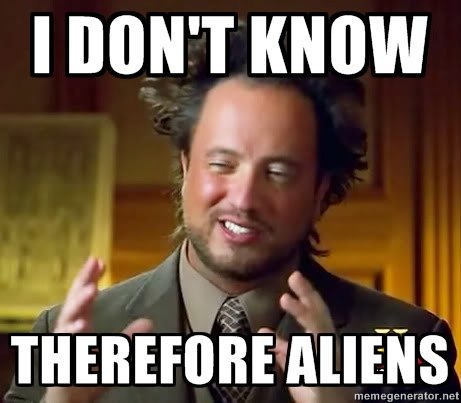
The biggest lesson we can get from both science and pseudoscience is that we have to use caution. Yes, we have science because of pseudoscience, alchemy before chemistry, astrology before astronomy, phrenology before anatomy, and many other examples. But we have a problem at the dawn of the XXIst century, and it has a lot to do with people saying “not everything is known, so there could be a chance that auras, spirits and such can exist.” The fact is that this is not a very cautious and reasonable way to confront the unknown, which is goal of science (I believe that ‘truth’ is a rather abstract concept when it comes to science). The best way we can be cautions, and it is totally acceptable in science, is to say I don’t know; rather than saying “it must be aliens, auras, spirits, vaccines, mermaids, the CIA, the government, the Illuminati, the jews, the blacks, the gays, the immigrants, the stars”, etc.
LikeLike
Many people now a days believe everything they see in the internet and don’t think about it. That is the problem with technology now a days, it doesn’t put people to think. Some people think about it, analyze it and believe it was faked but other people just say whatever they see in the social media
LikeLike
Ignorance has always been a present characteristic in humans, we are used to believe everything that is explained to us in a little more complicated way than what we usually think is true. We also fear changes and believe what is more convenient and normal. I have to admit I am not surprised by the ignorance present in some theories developed by some people. Based on that fact we can conclude that it doesn’t end in the person developing the stupidity, it continues by us believing the words of the ignorant and rejecting the words of the wise. Here is a list of Pseudoscience theories in different fields http://examples.yourdictionary.com/examples-of-pseudoscience.html
LikeLike
Pseudoscience is belief or practice which is falsely presented as scientific. It lacks supporting scientific evidence and cannot be reliably tested. People chose to belief evrything that appears in the social medias. It is hard to know which sources are reliable but by actually reading and doing research people can detrmine whether or not that source is trustworthy.
LikeLike
It is not surprising that people would believe in pseudoscience instead of science, besides it is the nature of the human being to believe what they want instead of what they should believe. Take the conflict of Islam at the middle east for example, the muslims want to convert the non-muslims to muslims because that is what the Qur’an tells them to do. This practice of the Islam is analogous to that of pseudoscience. What is really troublesome of the pseudoscience is that if a person uses it to influence people it becomes a weapon like the Qur’an from Islam.
LikeLike
The concept of ‘ideology’has to be discussed when talking about the nature of pseudoscience, religion, science etc. A brief research of the concept can give you a bit more insight as to what happens when people choose to believe science over pseudoscience and viceversa. I think that everyone, to varying degrees, is subjected to the effects of ideology.
LikeLike
In our generation most people believe everything said on the internet, which is a problem because not every site is trustworthy. Pseudoscience is a belief that lacks supporting evidence and can not be reliably tested. One example of pseudoscience is the global warming theory, which states that the world is becoming warmer and warmer due to the emission of greenhouse gases. The most precise data affirms that there has been virtually no global warming since 1998. http://www.conservapedia.com/Global_warming
LikeLike
It extremely sad how people believe all of the pseudoscience not because they believe but because they show it to others and more importantly to kids and those kids are the once that grow up thinking it true and when they are told the truth they don’t believe it make them doubt ideas as simple as the evolution theory this leads them to mistrust science which leads to bad choices especially when it comes how to further technology or something like doubting climate change even though most scientist agree that it is happening and that it is mostly caused by humans.
LikeLike
Basically, pseudoscience tries to makes us believe something that isn’t true. It makes us see things the wrong way, which sometimes is what we think is right just because it appeared on the internet, but we should make sure by researching about the topic in reliable sources. The following article presents pseudoscience in adult nutrition research and practice.
http://www.csicop.org/si/show/science_and_pseudoscience_in_adult_nutrition_research_and_practice/
LikeLike
When thinking about pseudoscience vs science, is it easy to talk to people about their, in many cases, decades old beliefs? The challenges of talking about pseudoscience revolve a lot on emotion and ego. In other words, feelings can be hurt, and people can even feel threatened. So the best way we ca address this problem is with civility and an open mind; something that, unfortunately, a lot of scientists are incapable of doing.
LikeLike
The dumbing down of the american people is no ones fault except THE PEOPLES. This generation has idolized stupidity and worshiped social media. im not even gonna talk about the popularity that jersey shore, kim kardashian or any of the housewife seasons but for us to allow our national news too feed us lies and biased opinions is where we fail.
pseudo science is a tricky box with many different topics and many different theories but this category of imaginary explanations is like a black hole as soon as something seems supernatural or imposible its thrown into the box and considered a taboo (then no serious scientist will touch it). im in no way defending the monstrosity that discovery and history channel have become but for serious pseudo science. for example if you believe in god you believe in a soul (or prity much every religion because the idea of a soul is universal common denominator) but the soul cant be touched, seen, or heard making into a kinda abstract phenomenon.
LikeLike
“the soul cant be touched, seen, or heard making into a kinda abstract phenomenon.”
Because of this, people still gravitate towards art, the community and beauty of religious practice—which can do a lot of good for a lot of people—, and philosophy (especially the field that studies concepts such as soul, consciousness, Being—metaphysics). In no way is any of this wrong. The mystical experience can be very satisfying. But I do believe that we need to be aware of our zeitgeist (the spirit of the times), what is currently happening. The actual world has a lot to do with science. And a lot of wonder, soul-stirring, awe, and amazement can be cultivated by pondering our feelings after seeing an eclipse through a telescope. Unfortunately, a lot of people still feel fear, the same fear the ancients had, when it comes to events like an eclipse, an event that can be perfectly explained with science. They are missing on a big chunk of the human experience, the feeling of wonder that comes from being aware that we are the universe. It doesn’t get any more magical than that.
LikeLike
It is not surprising that a person would believe pseudoscience over science. Since it is the normal thing to do for a human being. The conflict over at the middle east, mostly between muslims and non-muslims, is a good example to pseudoscience. Although the religious conflict isn’t exactly pseudoscience it is analogous in the practice of its trickery. The Qur’an commands the muslims to try and convert non-muslims to muslims. Here is more details about the Qur’an: http://www.youtube.com/watch?v=fgsrnmzxEUY
LikeLike
I can’t believe that after so many years of hard evidence, there are people, even professionals, who discredited the lunar landings. Skeptics will always try to discredited many achievement with little or no evidence at all. This may be causes of the dumbing down of the US. http://en.wikipedia.org/wiki/Third-party_evidence_for_Apollo_Moon_landings
LikeLike
Skepticism is not a bad thing, a healthy dose of it is necessary. I would no call these people ‘skeptics’; ‘Incredulous’ better describes them.
LikeLike
A very famous example of pseudoscience is The Bermuda Triangle. Many people believe that the cause behind the disappearance of planes and ships in that area is due to extraterrestrial and supernatural forces. Scientific research shows that those disappearances are caused by natural conditions. Two of the various causes that cause ships and planes to disappear in that area are that in that particular area there are methane fields underwater which cause ships to sink slowly and that the Bermuda triangle is one of the places on Earth in which a compass will point to the true north rather than to the magnetic north.
http://www.personal.psu.edu/afr3/blogs/SIOW/2011/09/explaining-the-bermuda-triangle.html
LikeLike
A good example of pseudoscience can be people believing that Earth is flat. Some people still believe that Earth is flat although we have proof and evidenve that Earth is not flat. Ignorants believe that Earth is a disc shaped planet that accelerates upward, producing the illusion of gravity. Here are pictures of Earth taken by astrounauts and satellites from space: http://www.space.com/21627-earth-from-space-pictures-gallery.html
LikeLike
Even during the early Renaissance, the period of the conquest of the new world, people new the Earth was round. The Church knew the Earth was round, contrary to we were lead to believe. Ancient Greeks with strings and wood, and a lot of patience, found out that the Earth was round. The following video shows us how an ancient Greek made this discovery:
LikeLike
The thing is humanity has always had its myths, legends and fantasy. Past cultures took these things as facts in life, they’re beliefs in other words. Now what’s happening now is no less different than the Greeks believeng in monsters and God’s. It’s just that as science has evolved and improved, it’s only given new material for the people to invent new fantasies. Only reason why there’s a science in the word “pseudoscience” is because it uses some actual scientific fact to back up its outrageous claim. Is such a thing bad or good? It can be both actually, when people use such things for entertainment and escapism I consider it to be alright, actually somewhat natural. It’s when you start saying they’re facts and the hard hitting truth that you loose me. And now, television has gotten worse and worse with such things. They should just change the name and call it “history is boring , add aliens and conspiracies and it’s cool channel” I bet teachers now a days can’t give a lecture without hearing a kid mention something he saw on ancient aliens. Our society is just mixing genre films with our reality.
LikeLike
“They should just change the name and call it “history is boring , add aliens and conspiracies and it’s cool channel” — I could not agree with this more, Agustín.
LikeLike
It is incredible to think that in today’s day and age, with all this technology in our disposal and information that can be so easily accessed via the internet, our smartphones, etc., people still believe in ridiculous claims known as pseudoscience. Claims such as the landing of the moon being fake are still thought to be true by some people even though it has been proven as preposterous the idea that the lunar landing of Apollo 11 was fake. I believe that even though information is so easily accessed in today’s modern world, and one would think that as information becomes more readily accessible people would utilize it in more efficient ways in order to educate themselves about such material, society as a whole is getting dumber because of the people’s reliance on technology to solve their problems without them having to think about the situation and solving it themselves (Such as using a calculator to find out what 7×6 is).
http://www.stateofdigital.com/how-the-internet-is-dumbing-down-the-next-generation/
LikeLike
With every technological achievement comes a set of challenges that nobody could foresee. This said, I think it is too early to say that the internet has definitively made a whole generation dumber. There are hints that say it is so, as stated by the author of the article posted in your comment. But I disagree with her in many things (we both belong to the Y generation, and I don’t think that my generation is smarter or dumber than the one before or after). We cannot avoid the fact that there are challenges with this new—very new—way of consuming information. Time will tell if we are dumber because of it. And I do not think that 20 years is enough time.
LikeLike
It is incredible to think that in today’s day and age, with all this technology in our disposal and information that can be so easily accessed via the internet, our smartphones, etc., people still believe in ridiculous claims known as pseudoscience. Claims such as the landing of the moon being fake are still thought to be true by some people even though it has been proven as preposterous the idea that the lunar landing of Apollo 11 was fake. I believe that even though information is so easily accessed in today’s modern world, and one would think that as information becomes more readily accessible people would utilize it in more efficient ways in order to educate themselves about such material, society as a whole is getting dumber because of the people’s reliance on technology to solve their problems without them having to think about the situation and solving it themselves (Such as using a calculator to find out what 7×6 is).
http://www.stateofdigital.com/how-the-internet-is-dumbing-down-the-next-generation/
LikeLike
Most of the stories we read on social media are false, but some people believe what they read. Those people don’t do enough research for them to know if what they are reading is true. You see all types of links on sites like Facebook giving all these false stories and theories. I had seen an article about many conspiracies of the moon landing and the aliens building the pyramids on these social media sites. People are generally attracted more to pseudoscience over science because they could find it interesting or because they need to find a way to make these theories more interesting. Before believing any of these conspiracies, one should ask themselves these questions. http://www.forbes.com/sites/emilywillingham/2012/11/08/10-questions-to-distinguish-real-from-fake-science/
LikeLike
To me, it is incredible to see how people can be so ignorant. We can see the scientific advances of the world, we can see how the technology used today to replicate such actions could not be found in 1969, yet they still choose to believe in crazy conspiracies. Honestly, some of the explanations of why people believe that the moon landing was a hoax seem reasonable, yet they can be proved wrong with the same science they choose not to believe in. Pseudoscience, though believed by many, is something that can’t be proved correct, therefor, it is only logical to not believe in it at all. Obviously, not many people think the way I do; Some people believe in the crazy conspiracies like The Bermuda Triangle, Brainwashing, and Hypnosis. Now the only problem with this is “What if some of these conspiracies are true? Would that make them science or would that make me a pseudoscience believer?”
LikeLike
http://www.popsci.com/article/science/dr-oz-defends-his-pseudoscientific-claims-harmless-flowery-language?dom=PSC&loc=recent&lnk=1&con=dr-oz-defends-his-pseudoscientific-claims-as-harmless-flowery-language
LikeLike
http://www.scientificamerican.com/article/what-is-pseudoscience/
LikeLike
the bermuda triangle is a very good example of pseudoscience check this out:
http://www.scientificamerican.com/article/what-is-pseudoscience/
LikeLike
Now a days people will believe anything you show them from the internet because they think that everything that’s on the internet that say “fact” is true. People should do just a little research before believing anything. Many people believe in conspiracies and here they explain on which conspiracies people believe in, why they believe in them, and how the media distributes it.
LikeLike
In today’s media-obsessed society, people can no longer distinguish fact from fiction. i mean, if it is said on t.v it must be true! “News” is now something we can get from The Comedy Channel in the Colbert Report. As Lewis Black stated in a wonderful movie about perception called Man of the Year starring the late Robin Williams, “they can put a survivor from Aushwitz next to a guy who says the Hollocaust never happened and because it’s tv, people actually take into consideration what the non-believer is saying!” Look at the the latest pseudoscience phenomena….mermaid sightings. There is actual “footage” so it must be true. People see what they want to see and accept fiction for fact.
LikeLike
I agree. Actually, The Colbert Report, Te Daily Show, and This Week Tonight are better sources for information that CNN, MSNBC and Fox News. There is actual journalism going on in these shows, something that mainstream stopped doing because of ratings and money. We are living in difficult times: war, economic crisis, and information crisis. These things feed each other.
LikeLike
http://pseudoscience.wikispaces.com/Conspiracy+theories
LikeLike
Many people believe in this pseudo-scientific conspiracies for a number of reasons. Mostly because they’re too ignorant to think about the claims conspirators make and also because they want to feel “powerful”. Another common example of a pseudo-scientific conspiracy theory is The Great Global Warming Conspiracy. Conspirators believe that Global Warming is fake and that scientists wish to achieve mass “thought control” or to create a “world government”. Why on earth would scientists conspire to trick everyone into thinking temperatures are rising? The only reasons actually posited by climate change skeptics are vague at best and ridiculously paranoid at worst.
http://www.treehugger.com/corporate-responsibility/debunking-the-great-global-warming-conspiracy-conspiracy.html
LikeLike
The Global Warming conspiracy is, in my opinion, the most dangerous one. Thanks for sharing it, Adrián.
LikeLike
The impact of pseudoscience has been expanding through new generations. I believe this presents a great problem for our society because it fortifies ignorance among humanity. Nowadays, people would rather rely on erroneous and unreliable sources of information rather than to do proper research and experimentation. Rather than depending on random websites, we should begin to recognize our own capacity to analyze.
LikeLike
I agree. A lot of people believe that thinking, reasoning, and analyzing information should be left to professionals such as journalists, scientists, psychologists, philosophers, among other professionals. The same technology that is, in many ways, causing pseudoscience to proliferate can be used by people to become wiser.
LikeLike
Pseudoscience in my opinion can be a lot of fun, but can be a big problem when people actually believe it’s real. People love to believe in these type of things because it makes the world “more exciting”, so they don’t look into the actual truth behind it, even though the truth can be just as interesting.
LikeLike
I agree and disagree, I believe we do need technology for many things like medicine or certain advances in weaponry but the truth is that people are getting dumber because of the massive spread of certain technological things. The fact is a lot of jobs don’t even exist anymore because machines or less people can do the same job.
LikeLike